What to do When You Can’t Go to Therapy: 40 Mental Health Tips for the Active Adult
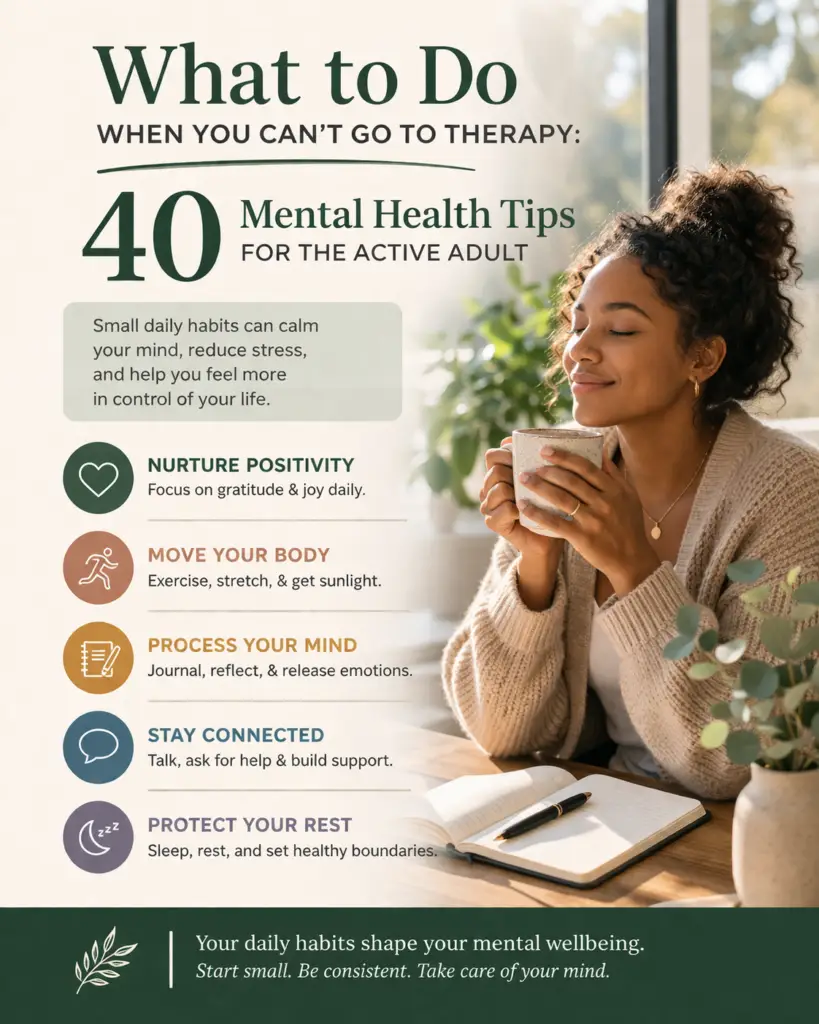
Not everyone can make it to therapy, and that’s okay. For most people, it’s the time constraints that come with being an adult; work, parenting, relationships, deadlines, and responsibilities that leave little room for formal care. Some people are stretched financially. Some others are simply not fans.
The truth is that protecting your mental health does not have to begin and end in a therapist’s couch. As someone who has worked closely with adults navigating stress, burnout, emotional overload, and life transitions, I want you to know that there are some small daily interventions that have powerful benefits to your mind.
Your daily habits shape your stress level, emotional resilience, clarity, and sense of control more than most people realize. Permit me to share 40 practical mental health tips every busy adult can use to stay emotionally grounded while drastically improving their mental wellbeing.
- Start a gratitude journal
Busy adults often live in problem solving mode, which can make life feel like a nonstop list of stressors, and can leave your mind running in a negative loop. Gratitude trains your mind to notice what is working instead of obsessing over what is missing. Writing down a few things you appreciate each day helps interrupt that pattern. It improves emotional balance, lowers stress, and helps you build a more hopeful outlook. Over time, gratitude increases psychological resilience because it reminds your brain that even difficult seasons still contain moments of meaning, support, progress, and beauty.
- Stretch daily
Contrary to popular opinion, stress is not only mental, it also lives in the body. Studies have shown that tight shoulders, clenched jaws, stiff hips, and neck pain are often physical signs of emotional overload. Daily stretching helps release stored tension and signals safety to the nervous system. Even five minutes of slow stretching can reduce muscle tightness, improve breathing, and create a sense of ease in your body, and when the body feels great, the mind often follows suit.
- Exercise for at least 30 minutes daily
Exercise is one of the most evidence-based ways to improve mood. It boosts endorphins, supports dopamine regulation, reduces anxiety, and helps discharge accumulated stress. For busy adults, movement also restores a sense of agency. When life feels chaotic, finishing a workout reminds you that you still have power over your choices and energy. It does not need to be intense. Walking, lifting weights, cycling, or a short run all work. For exercise, consistency matters more than perfection. Daily movement strengthens both the brain and the body.
- Meditation
A busy life can make the mind noisy. Meditation teaches you how to pause the mental traffic and return to the present moment. Even two to five minutes of stillness with slow breathing can reduce emotional reactivity and help you think more clearly. This practice strengthens attention, lowers stress hormones, and helps you respond instead of react. For adults constantly juggling responsibilities, stillness becomes a form of mental training. It improves focus, patience, and emotional regulation, making it easier to navigate pressure without feeling consumed by it.
- Progressive muscle relaxation
This one is a game changer for those who deal with a lot of anxiety. Progressive muscle relaxation helps you reconnect with your body and release hidden tension. By slowly tightening and relaxing different muscle groups, you teach your nervous system the difference between stress and calm. This is especially useful for adults who stay in a constant state of low-grade pressure without noticing how tense they have become. The technique reduces physical symptoms of anxiety, improves sleep quality, and creates a deeper sense of bodily awareness.
- Journal your thoughts
Journaling helps transform mental chaos into clarity. Thoughts that feel overwhelming in your head often become more manageable once they are written down. This practice helps you organize worries, identify patterns, and reduce rumination. For busy adults, journaling creates a private space to process stress instead of carrying it all day. It can also reveal recurring fears, assumptions, and beliefs that may be driving anxiety. Writing helps you slow down long enough to understand what is really happening beneath the surface.
- Take time to identify your triggers
Self-awareness is perhaps one of the foundations of mental wellness. If you do not know what sets you off, stress can feel random and uncontrollable. Learning your triggers helps you prepare for demanding situations instead of being blindsided by them. Maybe it is lack of sleep, criticism, conflict, financial pressure, or feeling ignored. Once you identify patterns, you gain the power to respond intentionally. This reduces emotional impulsivity and helps you protect your peace before stress escalates into burnout, anxiety, or conflict.
- Cut down alcohol
Alcohol may feel like quick relief, but the aftermath always leaves you feeling worse. It often worsens anxiety, low mood, sleep quality, and emotional instability. For many busy adults, drinking becomes a socially acceptable coping mechanism that quietly increases mental fatigue. Reducing alcohol helps your brain regulate mood more effectively and improves the quality of your rest. It also helps you face emotions directly instead of numbing them temporarily. Better emotional processing, more stable energy, and clearer thinking often follow when alcohol use is reduced.
- Get at least 6 to 8 hours of sleep Per Night
Sleep is how we recharge; it’s like emotional first aid. Without enough rest, your brain becomes more reactive, less patient, and less capable of rational thinking. Stress feels bigger when you are exhausted. Adequate sleep supports memory, emotional regulation, concentration, and resilience. For busy adults, sleep is often the first thing sacrificed, but it should be one of the first things protected. Consistent rest gives your mind the recovery time it needs to process the day and prepare for tomorrow.
- Drink enough water daily
Here’s a fun fact, our brain is made up largely of water. Hydration plays a bigger role in mental health than many people realize. Even mild dehydration can worsen fatigue, headaches, irritability, and concentration problems. When your body is under hydrated, your brain often interprets it as stress. Drinking water consistently supports energy, focus, and mood stability. A healthy mind needs a well-supported body, and water is one of the simplest ways to provide that support.
- Spend time engaging in a hobby
A hobby gives your mind a break from survival mode. When every waking hour is consumed by work, bills, obligations, and decision making, the brain begins to associate life with pressure alone. Hobbies reintroduce joy, play, creativity, and curiosity. Whether it is reading, sports, cooking, gardening, or music, hobbies activate healthy reward pathways and reduce stress buildup. They remind you that life is meant to be lived, not merely managed.
- Talk to at least one person who cares about you every day
Emotional isolation magnifies stress. A quick conversation with someone safe helps regulate your nervous system, reduce loneliness, and put problems into perspective. Sometimes the mind simply needs to feel witnessed. A brief check-in with a trusted friend, sibling, spouse, or mentor can create emotional relief that lasts the rest of the day.
- Stop comparing yourself with others
Comparison trains your mind to ignore your progress and obsess over someone else’s timeline. This fuels anxiety, shame, and dissatisfaction. A healthier mind focuses on alignment, not competition. The only comparison that truly helps is comparing who you are today to who you were yesterday.
- Stop suppressing your emotions
What you refuse to feel does not disappear. It often leaks out through irritability, resentment, emotional numbness, overthinking, or sudden breakdowns. Letting yourself feel emotions in a healthy way helps them pass instead of hardening inside you.
- Set a SMART goal
A scattered mind feels overwhelmed. SMART goals reduce mental noise by turning vague pressure into specific action. Clear direction lowers anxiety because your brain knows what to do next.
- Compliment at least one person per day
Giving genuine compliments improves connection and shifts your mind toward noticing what is good. This strengthens positive emotional circuitry and creates more warmth in your social world.
- Write down five things you are looking forward to
The mind needs hope. Anticipation creates emotional light in heavy seasons. Looking forward to meaningful moments protects against hopelessness and emotional flatness.
- Get sunlight daily
Sunlight supports serotonin, sleep regulation, and overall mood stability. Morning sunlight especially helps reset your internal clock and reduce sluggishness.
- Make a list of your strengths
Stress can distort self-perception. Listing your strengths helps challenge feelings of inadequacy and restores confidence in your ability to handle life.
- Go a full day without your phone
A phone free day helps reset your attention, reduce nervous system overload, and break comparison loops. Many adults feel mentally lighter after just one day of reduced digital stimulation.
- Learn to ask for help when you need it
One of the healthiest things an adult can do is stop carrying everything alone. Asking for help early prevents overwhelm from becoming crisis.
- Try new things
New experiences stimulate the brain, build confidence, and challenge fear-based thinking. Novelty helps prevent emotional stagnation.
- Embrace honesty
Dishonesty creates internal friction. Honest living reduces anxiety because your inner and outer world are aligned.
- Take more walks
Walking is moving meditation. It clears the mind, reduces cortisol, improves circulation, and often helps thoughts settle naturally.
- Avoid the news
Constant negative news exposure keeps the brain in a state of perceived threat. Protecting your mind sometimes means limiting unnecessary exposure to distressing information.
- Say no more often without apologizing
Boundaries are mental health care. Saying no protects your time, preserves your emotional energy, and reduces resentment.
- Practice positive self-talk
The way you speak to yourself becomes the emotional climate of your inner world. A kinder internal voice improves resilience and lowers shame.
- Celebrate small wins
The brain needs evidence of progress. Small wins create motivation, reinforce healthy behavior, and protect against discouragement.
- Separate what you can and cannot influence
This practice is incredibly powerful for anxiety. It redirects energy away from helpless rumination and toward effective action.
- Help someone else
Helping others gives perspective, meaning, and emotional lift. It reminds you that you still have value to offer even in stressful seasons.
- Do one thing daily, your future self will thank you for
This habit builds self-trust. Every small action becomes proof that you care about the life you are creating.
- Rest before fatigue
One lesson I often see adults learn too late is that burnout recovery takes longer than burnout prevention. Rest before you feel broken.
- Pray
Prayer helps many people process fear, uncertainty, and emotional pain. It can create calm, perspective, surrender, and renewed hope.
- Read good fiction
Fiction provides emotional rest, perspective, imagination, and healthy escape from stress loops.
- Cut off people who drain you
Some stress is situational, others are relational. Protecting your mind may require reducing access to chronically draining people.
- Learn to name your emotions
When you can name what you feel, you can manage it better. Emotional language turns confusion into clarity.
- Practice radical acceptance
One of the most liberating mental health skills is accepting reality as it is before deciding what to do next. Fighting reality multiplies suffering.
For a deeper breakdown, link this section to your Radical Acceptance article so readers can continue learning the principle in detail. Learn more about radical acceptance here
- Set a SMART goal and take daily steps
Big goals heal hopelessness when broken into daily movement. Small steps build momentum, confidence, and emotional stability.
- Listen to good music, sing, and dance
Music is one of the fastest ways to shift your mood. Singing and dancing release tension, improve mood, and help move emotion through the body.
- Forgive and let go of minor offenses
Small resentments accumulate into mental clutter. Forgiveness is not weakness. It is emotional freedom.
Final thought
If you have read this far, congratulations. You are now equipped with enough healthy skills guaranteed to improve your mental health.
Therapy is powerful, but small actions, repeated consistently, are what sustain mental health between life’s hardest moments. The goal is not perfection but building a lifestyle that makes emotional stability more likely.
You do not have to try all 40 at once. Simply choose 3-5 of these strategies and practice them every day for the next 7 days. That simple experiment can dramatically improve your emotional stability, clarity, and stress tolerance.