In my early days of working with college students, I there was this kid who got a lot of attention for the amount of interpersonal conflict he got into. Every other month, there was a new report. And it was never just one thing. Roommates, friends, even university staff.
Sitting in my office one day, he confided in me that he felt people hated him and that everybody was always out to get him. When I prodded, he couldn’t tell why this happens to him. I asked him when the last time was that he did or said something nice to someone who was not immediate family. He could not remember.
Another young lady, 21 at the time, was experiencing an eating disorder. I avoid using the words suffer or struggle here because as far as she was concerened, there was nothing wrong with her. Anorexia nervosa. She was as thin as a needle. Her voice was faint, and she looked like she might fall over any time. However, when she looked in the mirror, she saw herself of being of healthy weight.
I share these stories to illustrate what the absence of self-awareness can look like. And these guys are not alone. Recent research by Harvard psychologists suggests that only about 10 to 15 percent of people are truly self-aware.
So what exactly is self-awareness?
To be self aware is to be deeply acquainted with your inner world. It means understanding your emotions, thought patterns, personality traits, preferences, goals, attitudes, perceptions, sensations, and intentions. It is the ability to see yourself as others see you. To be mindful of the impact you have on others, while also recognizing the full extent of your strengths and weaknesses; your capacity for both good and bad.
One of the most rewarding aspects of self-awareness is that it does not only give you control over your inner world. It also gives you leverage in the external world.
It means knowing exactly what triggers you.
What energizes you and what drains you.
What you value most in relationships and in business.
You literally stop second guessing yourself
How can you increase your self-awareness?
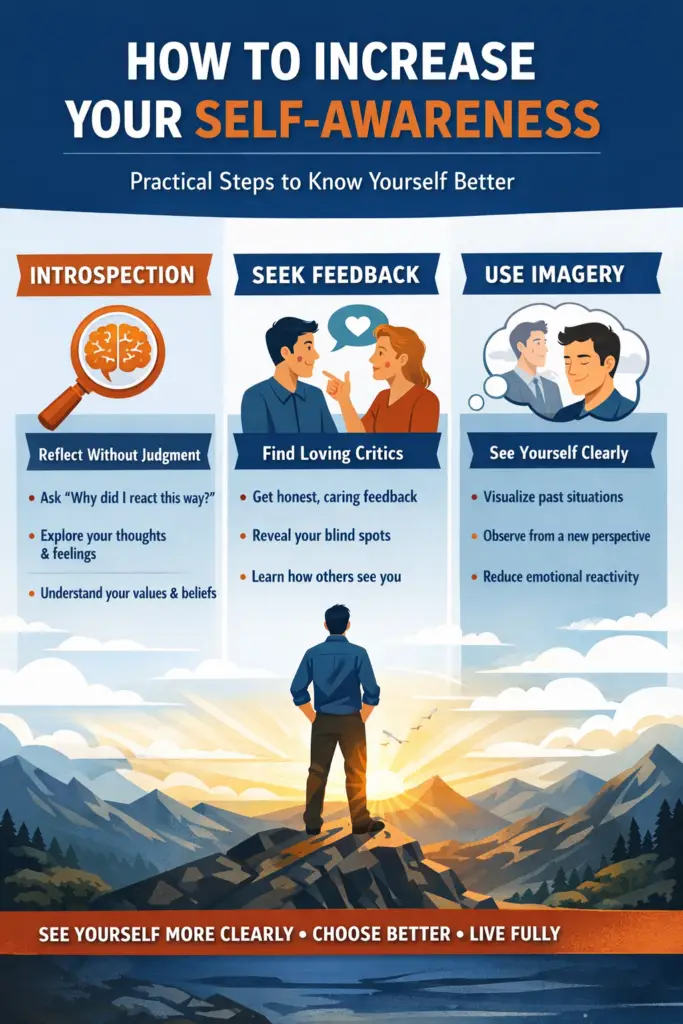
All self-awareness starts with introspection. Self-awareness begins with genuine curiosity about yourself. It is the willingness to understand your emotions, values, thought patterns, and reactions. It means looking back at your life and asking questions like what was I thinking then? why did I react this way or what belief is driving this response. The key is to approach introspection without judgment.
Another powerful way to increase self-awareness is by seeking feedback from loving critics. These are people who genuinely care about your growth and are willing to tell you the truth, even when it is uncomfortable. They help reveal blind spots in how we think, behave, and relate to others that are often difficult to see on our own.
Last, but certainly not least, is imagery. Mentally revisiting situations and observing yourself from a third person perspective creates psychological distance. This distance reduces emotional reactivity and allows clearer insight into behavioral patterns, assumptions, and emotional responses. Over time, this reflective practice strengthens metacognition, the ability to think about your own thinking, which is a core component of self-awareness.
In a nutshell, few things give us leverage over both ourselves, and other as much as self-awareness does; because when we see ourselves clearly, we become more confident and more creative. We make better decisions, build stronger relationships, and communicate more effectively.
Curious to know how self aware you really are??
This 5-minute Insight Quiz will help you learn more about how you view your self-awareness. Click here to get the quiz delivered in your email: https://emotionalmastery.substack.com/subscribe