If you are reading this, chances are you that have had a bout of anxiety at some point in your life. If you haven’t, I am impressed. However most people are familiar with that nagging feeling that something somewhere is about to go wrong; that my friends is anxiety. It is that uncontrollable worrying, hypervigilance, and tension that comes from anticipating future danger. Most times its brief, other times it lasts a long time.
Whenever the mind anticipates a dreadful outcome, the body enters a fight or flight mode and inevitably releases stress hormones like adrenaline and cortisol preparing you for action. Next thing you know, your heartbeat accelerates, your breathing becomes shallow, restlessness follows, suddenly you are sweating, your mind is racing, and you cannot concentrate.
The truth is that a certain amount of anxiety is normal. It is a biological alarm, one of the ways the brain signals that a situation or outcome is important enough for you to focus on. It could be an important interview, a difficult conversation, a risky decision, or an uncertain future. It’s the mind’s way of saying, “pay extra attention”.
What Anxiety Attack Looks Like
In normal amounts, anxiety is beneficial and can actually help performance. It only becomes a problem when the danger alarm becomes excessive or prolonged.
However, sometimes the brain mistakes stress, uncertainty, fear, or even a random body sensation as full-blown danger. And once that happens, the body goes into an emergency mode.
A panic attack is like normal anxiety turned all the way up.
Your chest tightens; you can hear your heart pounding through your chest. Your vision may become blurry; your hands start shaking. You are breathing hard. Your legs start to give way. Some people get hot flashes.
These bodily sensations feel so overwhelming that your mind begins to spiral, amplifying the fear. Oh no!, what is going on?
Then the body reacts to its own symptoms, creating a vicious cycle.
How To Stop a Panic Attack
The key to stopping a panic attack is understanding that panic attacks result from your nervous system being overwhelmed by anxiety.
Picture a sack slowly filling up with air. If too much air gets into the sack, it bursts. To prevent that from happening, you simply have to interrupt the cycle by releasing some of that tension.
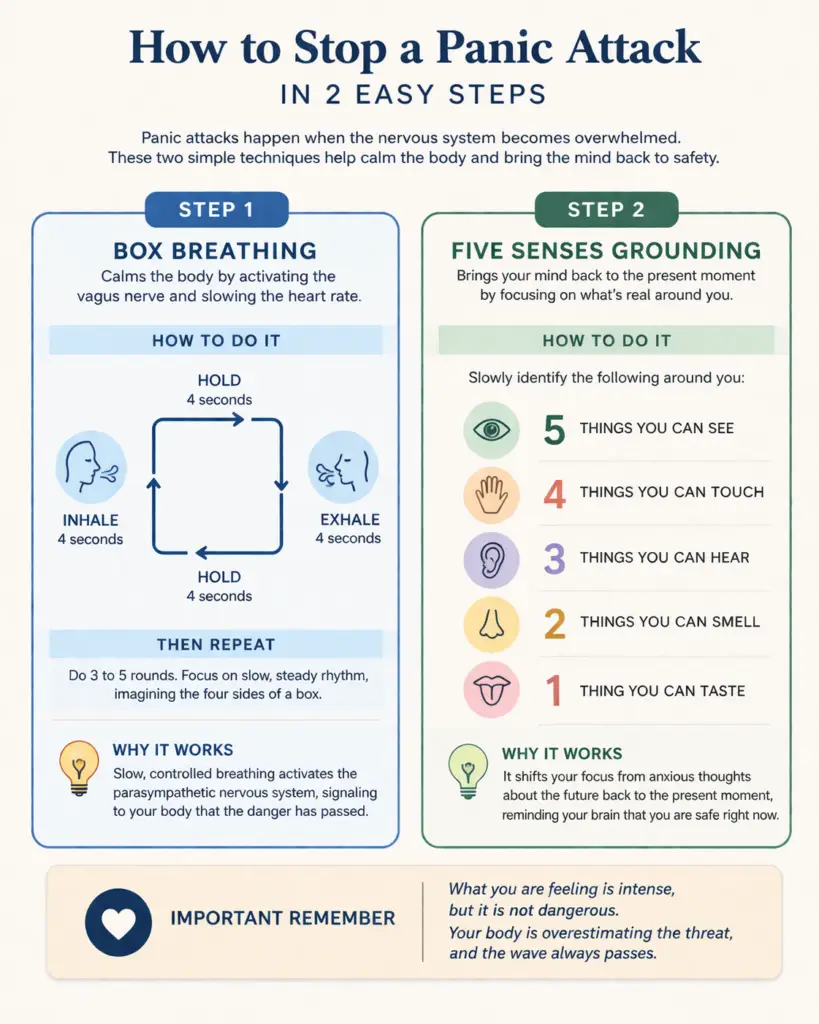
There are two proven strategies that help diffuse anxiety. These tools work remarkably well, and they are often the go-to practices therapists use when helping patients who struggle with panic disorders.
The First Strategy: Box Breathing
What Is Box Breathing?
Box breathing is a breathing technique that activates the parasympathetic nervous system. This is the body’s natural safe mode.
Scientists have found that when you breathe in a certain way, it activates the Vagus nerve, one of the most important nerves in the body for calming stress. It is the system responsible for slowing the heart rate, lowering blood pressure, relaxing muscles, and signaling to the brain that the threat has passed. Because the first thing a panic attack disrupts is your breathing, box breathing acts as the body’s internal brake pedal by slowing things down before they get out of hand.
Here is how to do it:
- inhale for 4 seconds
- hold for 4 seconds
- exhale for 4 seconds
- hold again for 4 seconds
Then repeat.
It is called box breathing because the pattern has four equal parts, like the four sides of a box. Imagine tracing the four sides of a square in your mind as you breathe in and out.
This mental image itself can be calming because it gives the mind something simple and repetitive to focus on.
Again:
- inhale for 4 seconds
- hold for 4 seconds
- exhale for 4 seconds
- hold again for 4 seconds
Then repeat.
Why this works is simple.
Slow breathing tells the nervous system that the threat is passing. Your heart rate begins to settle. Your muscles loosen. The brain receives the message that there is no tiger in the room.
Focus on rhythm, not speed, and after 3 to 5 rounds, you will begin to notice a difference.
The Second Technique: The Five Senses Grounding Technique
The five senses grounding technique works based on the premise that anxiety lives in the future.
At the onset of a panic attack, your mind starts racing through catastrophic possibilities.
What if I pass out?
What if I embarrass myself?
Am I having a heart attack?
However, by intentionally naming things around you while focusing on what is happening right now, grounding pulls you back into the present moment and reminds your brain that you are here, safe, and not in immediate danger.
And guess what?
The body cannot remain in full panic mode when the brain keeps receiving signals of safety.
Here is how the five senses grounding technique works.
Immediately ask yourself:
- 5 things you can see
- 4 things you can touch
- 3 things you can hear
- 2 things you can smell
- 1 thing you can taste
Take your time and slowly reconnect with your senses.
The biggest thing to remember during a panic attack is this: What you are feeling is intense, but it is not dangerous.
Your body is doing exactly what it was designed to do. It is just overestimating the threat.
Slow the breath. Reconnect with your senses.
And let the wave pass.