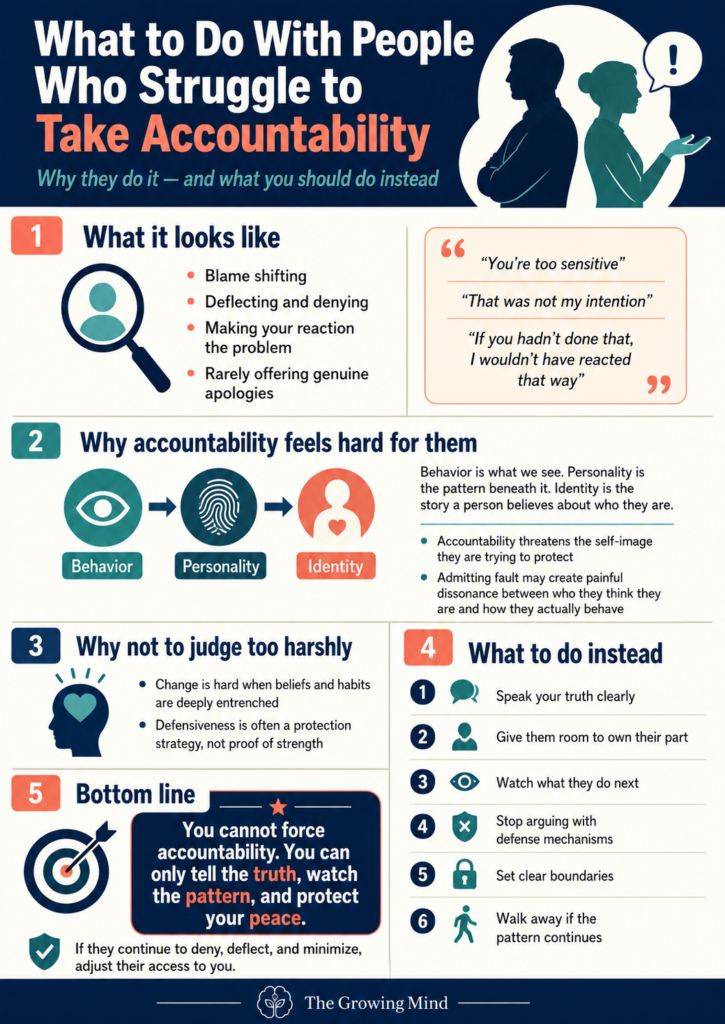
Dealing with someone who never takes accountability for their wrongdoings can be deeply frustrating. In this post, I explore why you should never judge them too harshly, and what you should do instead.
Anyone who has dealt with someone who never takes accountability for their actions knows that very few things are more emotionally exhausting. It could be a partner, friend, colleague, family member, or anyone you are close to.
“It is not my fault. This and that happened.”
“Here is why I did what I did.”
“If you had not done that, I would not have reacted this way.”
Everything and everyone is wrong, well, except them.
They would rather climb onto a moral high horse and make a thousand excuses before admitting they were wrong.
For them, the truth comes second; their narrative is what’s most important.
It often does not matter how much evidence you present. It does not matter how clearly you explain how their behavior hurt you. They will deflect, counter, deny, and sometimes leave you questioning your own reality.
No acknowledgment of wrongdoing.
No accountability.
No genuine apology.
In fact, rather than take accountability, these people have perfected the skill of shifting blame and making your reaction the problem.
Instead of “I am sorry I hurt you” they say, “You are too sensitive.”
“I was wrong” becomes “That was not my intention.”
“I need to do better” turns into “You always bring up the past.”
And before you know it, the conversation is no longer about what they did. It is now about your tone, your timing, your reaction, your sensitivity, and your inability to “move on.”
So, what makes it so difficult for some people to take accountability?
To understand this, we need to understand the relationship between behavior, personality, and identity. Behavior is what people do. It is the part of them we see, experience, and interact with.
Behind behavior is personality, which is the deeper pattern of how a person tends to think, feel, react, relate, and make meaning across different situations.
But beneath both behavior and personality is identity.
Identity is the story or belief a person holds about who they are in relation to the world around them. It is the internal blueprint from which people interpret life and organize their behavior. And identity does not come from nowhere. It is shaped by family, culture, religion, upbringing, personal experiences, trauma, social conditioning, and the stories people have been telling themselves for years.
Now, having said that, it is never easy for anybody to admit they are wrong.
Nobody enjoys being confronted with their faults.
But when presented with enough evidence, emotionally mature people usually come around. They may feel defensive at first. They may need time to process it. But eventually, they can reflect, acknowledge their part, and take responsibility.
However, people who chronically struggle with accountability often have an identity structure that prevents them from seeing their own faults clearly.
There is a painful dissonance between who they believe they are and how they actually behave.
In their mind, their actions are always justified, regardless of the effect on other people.
As far as they are concerned, they are good. They are fair. They are empathetic. They are the reasonable ones.
So, for people like this, accountability feels too risky.
Because to take accountability, they would have to acknowledge the truth about themselves. They would have to question old belief systems. They would have to admit that the version of themselves they have been protecting may not be as innocent, kind, or righteous as they imagined.
In essence, they would have to confront the possibility that they are not always good people in the story.
And that is too painful for some people.
The second reason you should not judge them too harshly is the issue of motivation and capacity to change.
You see, the older a person gets, the harder it can be to modify deeply rooted behavior patterns. The more entrenched the ego becomes, the harder it is to change. If their beliefs and narratives have already crystallized, it may feel easier for them to stay the same than to confront the painful work of growth.
This does not excuse harmful behavior.
But it helps explain why some people would rather deny reality than face themselves.
When people refuse or struggle to acknowledge obvious wrongdoing, even in the presence of evidence, it is often because accountability threatens the version of themselves they are trying to protect.
So, how do you deal with people who struggle to take accountability?
You don’t.
Do not waste your life arguing with people’s defense mechanisms.
You speak your truth once; or maybe twice if you really love them.
Then you give them room to own their part; then you watch what they do next.
If they continue to deny, deflect, minimize, blame shift, or make you the problem, you stop trying to force insight into them.
You set clear boundaries.
You adjust their access to you.
And when necessary, you walk away.
Because your job is not to drag people into emotional maturity.
Your job is not to keep explaining your pain until they finally agree that it matters.
Your job is not to prove reality to someone who benefits from denying it.
Your primary responsibility is to protect your peace.
At some point, you have to recognize that arguing, explaining, proving, and over explaining will not change someone who is deeply committed to avoiding accountability.
It will only exhaust you.
And in the process, you may begin to lose your own sense of clarity, confidence, and emotional stability.
So, tell the truth.
Give them a chance to own their part.
Watch their behavior.
And if nothing changes, believe the pattern.
Because accountability is not something you can beg out of people.
It is something they must be willing to grow into.